
by Don Whaley | Nov 5, 2018 | Articles, Mentors Corner
Your answer to this question will determine how you view the Bible but also it will have an eternal impact on your life. If the Bible is truly God’s Word, then we should cherish it, study it, obey it, and trust it. If the Bible is the Word of God, then to dismiss it is to dismiss God. The Bible is God’s revelation of Himself to mankind. The term “revelation” simply means that God communicated to us what He is like and how we can have a right relationship with Him. If the Bible truly is the Word of God, then it is the final authority for all matters of faith, religious practice and morals. There can be no doubt that the Bible does claim to be the very Word of God. This is clearly seen in Paul’s commendation to Timothy: “…and that from childhood you have known the Holy Scriptures, which are able to make you wise for salvation through faith which is in Christ Jesus. All Scripture is given by inspiration of God, and is profitable for doctrine, for reproof, for correction, for instruction in righteousness, that the man of God may be complete, thoroughly equipped for every good work.” (2 Timothy 3:15-17) One evidence that the Bible is truly God’s Word is in its unity. It is 66 individual books, written on 3 continents, in 3 languages, over a period of approximately 1500 years, by more than 40 authors from many walks of life. Yet the Bible is one unified book from beginning to end without a single contradiction. No other book is like this. It...

by Walt Henrichsen | Oct 22, 2018 | Articles, Mentors Corner
Balaam’s Sin “…which have forsaken the right way, and are gone astray, following the way of Balaam the son of Bosor, who loved the wages of unrighteousness.” 2Peter 2:15 When Christ addresses the church at Pergamos, He charges them with the sin of Balaam: “But I have a few things against thee, because thou hast there them that hold the doctrine of Balaam, who taught Balak to cast a stumblingblock before the children of Israel, to eat things sacrificed unto idols, and to commit fornication.”1 Numbers 22-24 records the incident where Balak, the king of Moab, requested God’s prophet Balaam to curse Israel on the Exodus. God refused to allow Balaam to curse His people, and so Balaam counseled Balak to engage in sexual promiscuity with Israel, thereby ensuring God’s curse. Jude and Peter tell us Balaam did this because he lusted after the wealth promised by Moab. Lust and covetousness are essentially the same; when you lust you covet, and vice versa. The object of your coveting determines what you call it. For the football player it may be being inducted into the pro hall of fame; for another it may be becoming the richest man in the world; for those in academia it may be becoming president of an Ivy League school; and so forth. Although it may be difficult on occasion to distinguish between a legitimate desire and coveting, whenever you break the commandment of God to attain your goal, you know you have committed the sin of Balaam. Balaam was endowed with a marvelous gift; God made him His prophet, which meant that he could...

by Micah Olson | Oct 2, 2018 | Articles, Mentors Corner
Forgiveness and Consequences “For we must all appear before the judgment seat of Christ, so that each one may be recompensed for his deeds in the body, according to what he has done, whether good or bad.” 2 Corinthians 5:10 The bible makes it abundantly clear that our actions in this life have eternal consequences. We do nothing to earn our way into heaven, because salvation is by grace and grace alone. But although salvation is in no way based on our works or our merit, it is equally true that the quality of our eternity is based on our works. How we invest our life on earth will determine how we live out eternity in heaven (see, e.g., Matthew 6:19-21, 1 Corinthians 3:11-15, and Revelation 22:12). Many modern Christians are uneasy with the teaching of eternal accountability, instead preferring to believe that God’s forgiveness wipes out all consequences of temporal (i.e. earthly) sin. However, the idea that forgiveness eliminates consequences is not biblical. As an example, consider the story of Israel’s rebellion at Kadesh Barnea, found in Numbers 13-14. God commands Moses to send spies into the Promised Land in order to see what the land is like (Numbers 13:1). Twelve spies, one from each tribe, go out on the mission. Two spies, Caleb and Joshua, give a good report of the land. They argue that Israel should go up and take possession of it, in obedience to God. But the other 10 spies argue that the people in the land are too strong for Israel. Sadly, the Israelites go against Caleb and Joshua’s counsel, and instead they...

by Walt Henrichsen | Aug 27, 2018 | Articles, Mentors Corner
“…give me neither poverty nor riches; feed me with food convenient for me. Lest I be full, and deny thee, and say, Who is the Lord? or lest I be poor, and steal, and take the name of my God in vain.” Proverbs 30:8-9 Most wealthy people handle their wealth poorly, allowing it to warp their values and hurt their lives. Admitting this to be true, most people who are not wealthy nevertheless feel that they are an exception; they can handle wealth. The love of money finds its origin in our desire to avoid the pain of financial insecurity. The phrase “he is financially independent” means that he is insulated from the gyrations of an uncertain economy. God does not want you “independent,” but rather dependent upon Him. People perceive money as the key to freedom, and thus their goal is in conflict with God’s goal for them. The servant of Christ understands this tension between his appetite and God’s will, and prays for the balance between poverty and riches. He knows in his depravity that he can err in either direction of greed and pride; in his greed he steals and in his pride he renounces his need of God. He asks and receives not “because he asks amiss that he may consume it upon his lusts.” (James 4:3) Agur, the writer of this proverb, offers a prayer that is an accurate test of a man of God. He seeks for deliverance from both extremes, knowing that greed can easily overpower his conscience. He throws himself upon the mercy of God, asking that the Lord give him...

by John Hartshorn | Aug 13, 2018 | Articles, Mentors Corner
THE SIGNIFICANCE OF SEQUENCE One of the consistent themes of God through the whole of the Bible is “order”. That is “order” as in the noun used to note a specific sequence. That is clearly seen in Old Testament by noting “first” things. There are first born, first fruits, first day, first offspring, etc. The use of “first” carries into the New Testament as well with well known verses such as Matthew 6:33 “But seek first His kingdom and His righteousness and all these things shall be added to you”. (NASB) Even a basic reading of the bible should confirm the idea that God is rather particular about the “order” in which His commands are observed. His instructions to the Israelites in regard to the sacrifices, and the specific order required when the movement of the cloud during the Exodus dictated the movement of the tabernacle (Numbers Chap. 2-4), are two OT examples. Let us consider a few often cited passages where the “order” is noteworthy: Romans 12:1-2 notes a sequence in the commands that one is to l)”present your bodies a living and holy sacrifice..” 2) “…not be conformed to this world..” 3) “be transformed by the renewing of your mind”. Luke 9:23 (also Matt. 10:38 and Mark 8:34) records Christ telling anyone who would be His follower to l) “deny himself’ 2) “take up his cross (daily)” 3) “follow me”. James 4:7-8 1) “Submit therefore to God” 2) “Resist the devil and he will flee from you 3) “Draw near to God and He will draw near to you” I find these mentioned interesting for the following...
by Gayle Jackson | Jul 9, 2018 | Articles, Mentors Corner
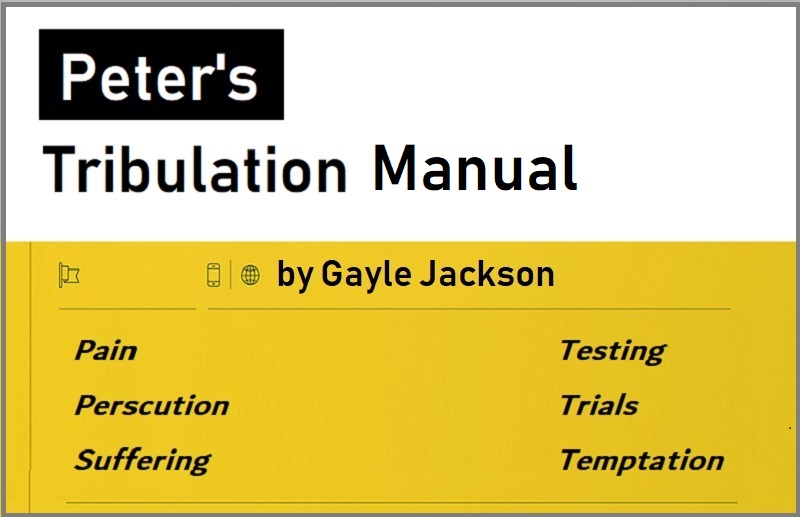
The book of 1 Peter, I would argue, is Peter’s “manual” for how not to embarrass Christ amidst Tribulation (as Philippians is Paul’s). An interesting passage to consider in regard to Tribulation is 1 Peter 4:12. In it Peter exhorts us, “not to think it strange”. 1 Peter 4:12 Beloved, do not think it strange concerning the fiery trial which is to try you, as though some strange thing happened to you; Do you think it strange when pain, persecution, suffering, testing, trials, temptation… tribulation enters into your life? (although there are some slight differences in the meaning of the words above, for the purpose of these articles, I use these words essentially as synonyms) Some irony with this verse is that earlier in his life, Peter thought it strange concerning Jesus: If we look back in the Gospels in Matthew 16, Jesus is telling the Apostles His plans to go to Jerusalem, suffer many things and be killed. Peter responds and essentially says: “NO WAY, I WILL NOT LET THAT HAPPEN”. Thus he provokes Jesus’ rebuke in Matthew 16:23 But He turned and said to Peter, “Get behind Me, Satan! You are an offense to Me, for you are not mindful of the things of God, but the things of men.” Jesus understood something that Peter did not at that point in his life. Specifically, that tribulation is normal in the life of God’s children. Are you more like Peter or Jesus in this manner? Do you understand that tribulation is normal in your life, even GRACIOUS? To the degree that you think tribulation is strange (to the...


Recent Comments