
by Nigel Pink | Sep 10, 2018 | Articles, Testimonies
Preach Surely you remember, brothers and sisters, our toil and hardship; we worked night and day in order not to be a burden to anyone while we preached the gospel of God to you. (1 Thessalonians 2:9) The Greek word that is most often translated as ‘preach’ is κηρύσσω – kérussó (Strong’s 2784). The word in the Koine has an uncertain origin but the definition is ‘to be or act like a herald’ or ‘to proclaim’. The role of a herald has changed with time. Coming to the English language from the Old French heraut from the Frankish via herewald, literally ‘war-ruler’, in other words a martial or commander, it has three distinct contemporary meanings: 1. A messenger 2. A harbinger 3. A steward (of heraldry -a rank/position at the College of Arms) All three meanings are relevant to the ‘preacher’ of the Gospel, who is entrusted (stewardship) with a message of the coming of the Kingdom of God. In the same passage to the one above Paul says: …we speak as those approved by God to be entrusted with the gospel. (v4) But there is another meaning, especially given to the verb ‘to herald’ and this is ‘sing the praises of’ – this is surely what all Christians, joy-filled with the fruit of the spirit, wish to do? However, sadly this is often not the case. Nowadays, the idea that a Christian should ‘preach the Gospel’, in other words, proclaim the good news of Jesus to those not in faith that he is the Christ, has become frowned upon. In conjures images of street corner evangelists ranting at...

by Walt Henrichsen | Aug 27, 2018 | Articles, Mentors Corner
“…give me neither poverty nor riches; feed me with food convenient for me. Lest I be full, and deny thee, and say, Who is the Lord? or lest I be poor, and steal, and take the name of my God in vain.” Proverbs 30:8-9 Most wealthy people handle their wealth poorly, allowing it to warp their values and hurt their lives. Admitting this to be true, most people who are not wealthy nevertheless feel that they are an exception; they can handle wealth. The love of money finds its origin in our desire to avoid the pain of financial insecurity. The phrase “he is financially independent” means that he is insulated from the gyrations of an uncertain economy. God does not want you “independent,” but rather dependent upon Him. People perceive money as the key to freedom, and thus their goal is in conflict with God’s goal for them. The servant of Christ understands this tension between his appetite and God’s will, and prays for the balance between poverty and riches. He knows in his depravity that he can err in either direction of greed and pride; in his greed he steals and in his pride he renounces his need of God. He asks and receives not “because he asks amiss that he may consume it upon his lusts.” (James 4:3) Agur, the writer of this proverb, offers a prayer that is an accurate test of a man of God. He seeks for deliverance from both extremes, knowing that greed can easily overpower his conscience. He throws himself upon the mercy of God, asking that the Lord give him...

by John Hartshorn | Aug 13, 2018 | Articles, Mentors Corner
THE SIGNIFICANCE OF SEQUENCE One of the consistent themes of God through the whole of the Bible is “order”. That is “order” as in the noun used to note a specific sequence. That is clearly seen in Old Testament by noting “first” things. There are first born, first fruits, first day, first offspring, etc. The use of “first” carries into the New Testament as well with well known verses such as Matthew 6:33 “But seek first His kingdom and His righteousness and all these things shall be added to you”. (NASB) Even a basic reading of the bible should confirm the idea that God is rather particular about the “order” in which His commands are observed. His instructions to the Israelites in regard to the sacrifices, and the specific order required when the movement of the cloud during the Exodus dictated the movement of the tabernacle (Numbers Chap. 2-4), are two OT examples. Let us consider a few often cited passages where the “order” is noteworthy: Romans 12:1-2 notes a sequence in the commands that one is to l)”present your bodies a living and holy sacrifice..” 2) “…not be conformed to this world..” 3) “be transformed by the renewing of your mind”. Luke 9:23 (also Matt. 10:38 and Mark 8:34) records Christ telling anyone who would be His follower to l) “deny himself’ 2) “take up his cross (daily)” 3) “follow me”. James 4:7-8 1) “Submit therefore to God” 2) “Resist the devil and he will flee from you 3) “Draw near to God and He will draw near to you” I find these mentioned interesting for the following...

by Jerry Bangert | Jul 30, 2018 | Articles
THE LOVE OF GOD “But the goal of our instruction is love from a pure heart and a good conscience and a sincere faith. (1 Timothy 1:5) The cruelty of God is more loving than the love of men. If this were not so why do we need an entire Bible to teach us to love? In Christianity there are two “Gods.” The first is God as I wish Him to be and He is simply an extension of myself and He is very easy to love. He thinks and acts like I do but He does not exist except in my imagination. The second and true God is the One who is revealed in scripture and being quite unlike me is much harder to love, not because of a deficiency in Him, but of one in me. He violates my conception of love in a thousand ways and on every page of the Bible from causing calamity (Isaiah 45:5-7) to killing babies who have done no wrong (2 Samuel 12:13-18). And in this and countless other examples He demands that we affirm not just His right but His goodness in all of this. GOD IS LOVE! Love is a seamless garment and can only be defined by Him. Our’s is an all too human love. The commandments are the backbone of what it means to love God and man and when we ignore some of them that we don’t like we rend the garment that is love. The commandment to discipline the body of Christ is illustrative of this(Matthew 18:15-20 & 1 Corinthians 5). To discipline is to...
by Gayle Jackson | Jul 9, 2018 | Articles, Mentors Corner
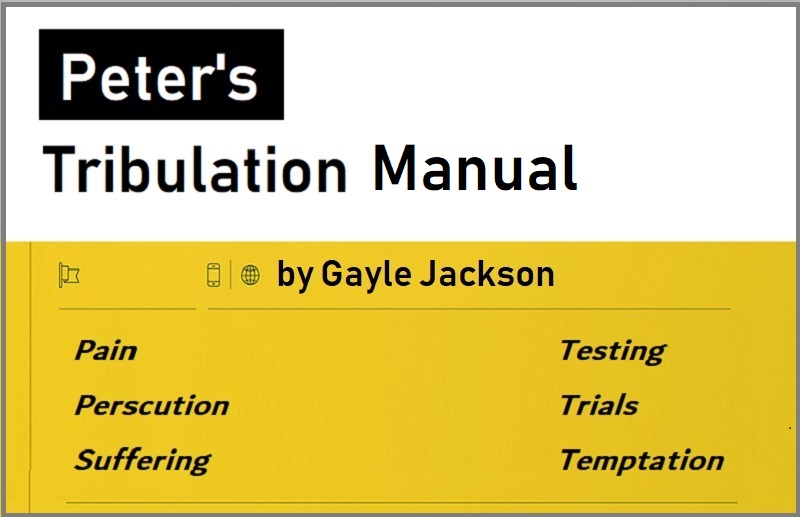
The book of 1 Peter, I would argue, is Peter’s “manual” for how not to embarrass Christ amidst Tribulation (as Philippians is Paul’s). An interesting passage to consider in regard to Tribulation is 1 Peter 4:12. In it Peter exhorts us, “not to think it strange”. 1 Peter 4:12 Beloved, do not think it strange concerning the fiery trial which is to try you, as though some strange thing happened to you; Do you think it strange when pain, persecution, suffering, testing, trials, temptation… tribulation enters into your life? (although there are some slight differences in the meaning of the words above, for the purpose of these articles, I use these words essentially as synonyms) Some irony with this verse is that earlier in his life, Peter thought it strange concerning Jesus: If we look back in the Gospels in Matthew 16, Jesus is telling the Apostles His plans to go to Jerusalem, suffer many things and be killed. Peter responds and essentially says: “NO WAY, I WILL NOT LET THAT HAPPEN”. Thus he provokes Jesus’ rebuke in Matthew 16:23 But He turned and said to Peter, “Get behind Me, Satan! You are an offense to Me, for you are not mindful of the things of God, but the things of men.” Jesus understood something that Peter did not at that point in his life. Specifically, that tribulation is normal in the life of God’s children. Are you more like Peter or Jesus in this manner? Do you understand that tribulation is normal in your life, even GRACIOUS? To the degree that you think tribulation is strange (to the...

by Walt Henrichsen | Jun 18, 2018 | Articles, Mentors Corner
“For the Father judgeth no man, but hath committed all judgment unto the Son.” John 5:22 How do you prepare for the day when you must stand before Jesus and be judged by Him? Obviously, you must school yourself in being His obedient slave. As Jesus Himself modeled: “…I seek not My own will but the will of Him who sent Me.” John 5:30 More than life, you want to please your Master, even if it means appearing foolish in the sight of others. A slave should have no expectations. If you view yourself as the property of Jesus Christ, and He does something you do not like, if He offends your sense of justice, that is His prerogative. When you take His yoke, you go and do what He wants, not what you want. You are involved in the lives of people because that is His will for your life. Again and again Scripture reminds you that people will abuse you. Even though you are fair, helpful, and kind to others, it is unrealistic to expect others to treat you the same way. Because you understand your depravity and propensity to sin, you prepare for Judgment by living a life of perpetual repentance before Him. You are best served if you condemn yourself before God and hope that He will see things differently when He judges you, rather than justifying yourself and finding that He sees things differently when He judges you. For more articles by Walt...


Recent Comments